
What Are Cryptocurrency Trading Platforms
A cryptocurrency trading platform is, at its core, a space where people come together to buy and sell digital coins like Bitcoin and Ethereum. I like to think of it as a meeting room that runs on software and the internet. Just like a well-facilitated workshop, the setup can be low-cost or even free when the middleman isn’t extracting rent. Traders and investors hold accounts and execute trades across markets - no physical handshake required.
The ideal platform, much like a healthy meeting culture, uses a solid database to boost safety, surface clear information, and help trades happen fast. You can search, set your terms, and make deals without ever meeting the other party - no awkward icebreakers needed. A dedicated cryptocurrency trading website often layers on live price feeds, news, and chart tools. That helps a regular user trade with less guesswork. The web-based setup lets traders signal intent, set rules, and negotiate prices based on pre-agreed terms - a kind of structured conversation between strangers.
Two broad kinds of trading platforms
- Proprietary platforms built by big broker firms to match their internal playbook
- Commercial platforms designed for everyday users and day traders, with ease of use front and center
Most commercial platforms come stocked with charts and news so you can study the market like a facilitator reading the room. If you want to be a self-sovereign blockchain trader on your own terms, a decentralized type gives you direct control of your funds - we’ll get to that shortly. The ideal trading platform should use a structured database to enhance security, information transparency, and provide secondary market liquidity, much like a shared workspace that captures room intelligence.
Centralized And Decentralized Exchanges
The crypto market, like any group dynamic, has two main types of exchanges. Centralized ones (CEXs) work like old-school banks: a company runs the show and holds your coins. Decentralized ones (DEXs) run on blockchain with no middleman - you keep your own money and your own keys.
I like to tell new folks: the main crypto exchanges are still mostly centralized, but DEXs are steadily growing. Both let you trade, yet safety and control differ. On a CEX you trust the firm; on a DEX you trust the code. Crypto exchanges are digital marketplaces where users trade various digital currencies - they provide a secure environment for millions to step into the crypto economy, much like a well-designed meeting invites broad participation.
Parts Of A Centralized Exchange
A centralized exchange has many moving parts - think of it as the backend of a facilitated event. At the core is the trade engine. It takes orders and matches buyers with sellers at the best price. It communicates through message systems and stores data in order books and trade feeds. Modern trading engines link with blockchain to make asset trades faster and keep safe storage on chain.
Key parts of a CEX
- Trade engine that matches orders quickly
- Order books that show open buy and sell offers
- Trade feeds that record finished trades like a receipt book
- Market data feeds that give live prices from outside sources
- Analytics that spot unusual patterns and improve the user experience
- Liquidity providers that keep markets steady
- Security and monitoring that guard every step
The trade engine operates as a stateless service - it processes and matches trading orders at the best available prices.
Order books are like a bulletin board where people post what they want to buy or sell before a deal closes. Trade feeds are the history of what already happened - a paper trail. Real-time data keeps prices fair, and security sits on top of everything from sign-up to withdrawal. The system uses blockchain nodes and wallets to settle and store user crypto, acting as custodians; they can build their own chain or lean on special services.
Popular Cryptocurrency Trading Platforms
There are many names out there. People often ask me which app is best for crypto trading and I tell them it depends on your needs. The best crypto exchanges to use are the ones with low fees, solid safety, and screens that don’t fight you.
Well known platforms
- Binance: large venue, many trading pairs, low fees, margin and stop-limit tools
- Coinbase: beginner-friendly, insured assets, low fees, pro version for big traders
- BitMEX: margin trading focus with high leverage but higher fees
- Kraken: operating since 2011, wide coin support, strong security, a bit complex for newcomers
- Robinhood: commission-free stocks but no crypto trading support
- Kucoin: smart charts, stop-loss and take-profit, many coins
- Gemini: New York trust company, smooth interface, limit and market orders
- Crypto.com: user-friendly, many coins, margin and stop-loss features
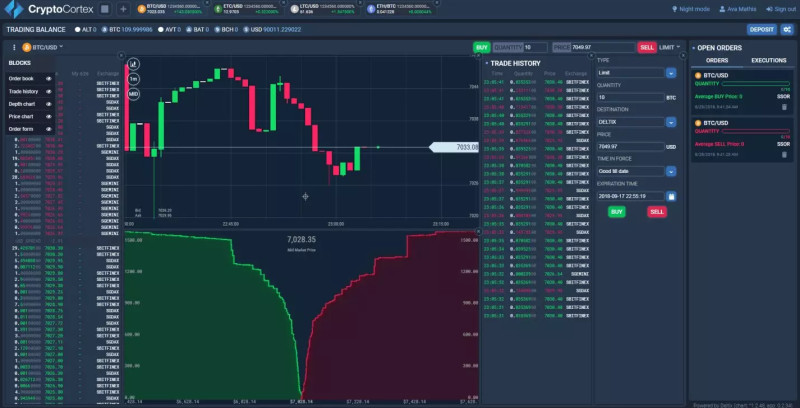
- CryptoCortex by Deltix: built for big investors with secure tools, links to many venues
Binance earns love for cheap trades and a clean look. Coinbase is a leading US platform with a pro arm called Coinbase Prime for large clients. Kraken has been around since 2011 and offers margin and futures for pros. If you want the lowest fees for crypto , Binance and Kraken are often named. BitMEX is for leverage fans, but its fees bite.
Robinhood is fine for stocks yet skips crypto. Kucoin and Crypto.com give deep chart tools. Gemini is regulated by NYDFS, which some find calming. The best crypto leverage trading platform in the USA might be BitMEX or Kraken for futures, but check the rules in your area. CryptoCortex was built by Deltix to bridge the gap between institutional investors and the crypto market. It offers separate setups for brokers, dealers, and exchanges with FIX and multicast data streaming, plus REST and web sockets, linking to more than 15 venues.
Tools For Day Trading Crypto
Day trading means buying and selling within a single day - not a long hold. To do it well you need good tools. The best way to trade crypto for a day trader is to use aids that surface trends and manage risk. Technical analysis studies past price data to anticipate future moves.
Common help tools
- Technical analysis tools like charting software and indicators
- Trading bots that auto buy or sell on set rules
- Portfolio apps to track coins and set price alerts
- News and market data sites for fresh info
- Advanced charting, stop-loss, margin, limit orders on platforms
Some folks use bots to trade while they sleep - a kind of facilitation that runs without a human in the room. I think a simple portfolio app is a must for any blockchain trader . News feeds keep you sharp on a crypto dip that might be a buy opportunity. Many platforms bake these features right in. Trading bots are software programs that execute trades based on predefined rules; they can be set to buy or sell on price moves or indicators.
High Frequency Trading And Big Players
High frequency trading (HFT) uses super-fast computers and math to profit from tiny price gaps. The crypto market swings a lot, which attracts these bots - much like a chaotic meeting draws interrupters. Bitcoin volatility has been near 70 percent, well above stocks. HFT needs high volumes and works best in volatile markets.
HFT strategy types
- Market making: buy and sell in microseconds for spread profit
- Momentum: catch short-term price moves
- Liquidity detection: spot other trader actions
- Arbitrage: exploit price difference between similar assets
The cryptocurrency market is particularly attractive to automated traders because of its high volatility.
Exchanges added features for big firms. Colocation lets them place servers in the exchange data center to cut delay. APIs let programs talk to the server fast. Coinbase Prime and Binance institutional accounts serve pros. Sliding fee scales reward those who add liquidity. The crypto market runs 24 hours like forex. Over 1,700 cryptocurrencies and 180 fiat currencies give arbitrage chances.
FPGAs are hardware that could speed trading 1000x but aren’t widespread in crypto yet. A flash crash risk is real - a bad HFT algo once wiped $1 trillion from US stocks in minutes back in 2010. Crypto is smaller, so a crash could hurt badly. Limits exist: Binance caps at 100 Bitcoin per day per user, Bittrex limits open orders. API restrictions: Binance 1,200 requests per minute. Liquidity mirage can leave small traders behind.
Security And Famous Hacks
Safety is the top priority on any platform - it’s the emotional safety of your capital. You want a place with a clean record, insurance, and few breaches. I cannot stress this enough: check the past before you trust. Vulnerabilities in smart contracts and wallet flaws caused over 70 percent of large attacks through 2022.
Early big attacks
- Mt. Gox (2011–2014): up to 850,000 Bitcoin lost, key flaws
- Bitfinex 2016: 120,000 Bitcoin stolen via multi-sign key compromise
- Coincheck 2018: 46,000 Bitcoin taken from hot wallet without multi-sign
Almost $7.2 billion in cryptocurrency was stolen as of end of 2022, with those three outliers about 15 percent of total losses.
These hacks teach us to keep big funds out of a single hot wallet. Use multi-sign checks. Watch privileged accounts. Some p2p crypto exchanges or DEXs avoid custody risk by design. But even code can have flaws. Smart contract bugs caused over 70 percent of large attacks through 2022. Known holes were reported for 20–50 percent of hacks in 2022. Key exposure accounted for 4–16 percent in 2022.

Since 2011, 56 exchange hacks led to $1.63 billion in losses per one report - that shakes trust. Still, the best crypto exchanges to use today invest in monitoring and key care. Look for proof they test and track holes. Best practices include key management, smart contract transparency, multi-sign, continuous testing, and least privilege for privileged accounts.
How To Choose A Trading Platform
Picking a spot to trade can feel like a maze with no facilitator. I say start with your goals - that’s your meeting purpose. Want quick profit or long hold? Ok with high risk? Then check safety, fees, and features. Different traders need different functions: day traders need market depth charts and secondary quotation; option traders need visualization tools.
Things to weigh
- Know your trading style and goals
- Assess platform security and breach history
- Compare fees and feature sets
- Test with demo or trial accounts
- Read user feedback but stay critical
Most prefer low-priced platforms but trade-offs exist. Some platforms work only with specific brokers. Reputation matters. A day trading platform may require at least $25,000 in equity in account. Option platforms may require approval. Newcomers should start small, learn, and use risk control.
The best way to trade crypto for a beginner is to use a simple screen and small money. A cryptocurrency trading website that offers a practice mode is gold. Don’t rush. Learn the order book first. In Canada many start with 100 CAD and grow from there.
Trading In Canada
For Canadian users, top exchanges include Kucoin, Gemini, Crypto.com, Kraken, and Binance. The steps are alike: make account, verify ID, link pay, deposit, then trade. Kucoin starts by creating an account with email and password, verifying identity, linking payment, and depositing. Supports Bitcoin, Ethereum, Litecoin. Use advanced charting.
Canadian friendly platforms
- Kucoin: email sign-up, verify, deposit, advanced charts
- Gemini: name, email, phone, fund, place limit or market orders
- Crypto.com: sign up and deposit via many methods
- Kraken: verify, pick pair, place order, watch trade history
- Binance: email sign-up, ID check, add funds, use stop-loss
Gemini: create account with name, email, phone; fund after verification; place buy/sell on order book with limit or market orders. Crypto.com: sign up, deposit via various methods. Kraken: create, verify, deposit, select pair, place market or limit order, monitor order book and trade history. Binance: create with email and password, verify with ID and address, add funds via crypto, card, or bank; use trading interface for limit and stop-loss orders; withdraw via strict security. Stay informed on market trends and use risk care.

Public Companies In Crypto Space
Beyond the exchanges, many public firms touch crypto. Theia Insights model lists ones with real operations. Coinbase Global leads the US with 0.46 crypto exposure. Block holds Bitcoin via Cash App. Marathon and Riot mine Bitcoin. Galaxy Digital mixes crypto advisory and banking.
Some noted public players
- Coinbase Global Inc: top US exchange with retail and pro services
- DeFi Technologies: crypto funds and exchange exposure
- Galaxy Digital: crypto advisory and banking mix
- WisdomTree: funds with blockchain and crypto bits
- Interactive Brokers: trading firm with crypto access
This list shows crypto is not just coins, it’s a web of firms. But the main crypto exchanges remain the direct places to trade. When you read news, know that big firms may be behind the screen. Many of these companies are tagged with crypto exposure scores based on their actual operations.
Cloud Setup For Exchanges
Many exchanges run on cloud tech - a kind of virtual facilitation space. A common blueprint uses AWS parts. Front end via Amplify and CloudFront. Core on containers. Blockchain nodes on servers. Wallets secured with key management. External provider connections use Transit Gateway, NAT, VPN, Direct Connect.
Basic cloud pieces
- Front end: Amplify, Route 53, CloudFront for users
- Core: Fargate with ECS or EKS for trade engine
- Data: Aurora, ElastiCache, DynamoDB, S3 for storage
- Market data: Kinesis or MSK streams, EventBridge
- Security: IAM, Shield, GuardDuty, WAF, CloudTrail
Pre-trade steps use S3, Glue, Lake Formation, Redshift, Athena, QuickSight, SageMaker, Bedrock, Lambda. This kind of setup helps a new exchange start fast and stay safe. It also meets rules in places where registered exchanges follow guidance. The goal is to keep user assets protected at every step from onboarding to off-boarding.
My Simple Take On Picking Platforms
I have read a lot and tested a few. My advice: don’t get dazzled by fancy words - collaboration begins with authenticity, and so does trading. A good cryptocurrency trading platform is one you understand and that doesn’t lose your coins. Start with a known name, use small money, learn the screen. If you see a crypto dip and feel fear, that’s normal.
Choosing the right exchange can make a huge difference in terms of security, fees, and trading features.
The best way to trade crypto is with a calm head and a plan. I keep my funds split, use multi-sign where I can, and never trust a site with no track record. You should too. A blockchain trader who stays careful will sleep better at night.

Comments on “How to Pick Cryptocurrency Trading Platforms That Genuinely Work for You - No Illusion of Control”
No comments yet. Be the first to share your thoughts.