
What a Coin Market Cap App Actually Shows
I keep a browser tab open to CoinMarketCap most days. It's the go-to spot for a quick look at prices, rankings, and headlines. The mobile app promises the same info in your pocket. But before you rely on any coin market cap app for serious research, you need to know what the numbers actually tell you - and what they don't.
The Market Cap Formula and What It Misses
Market capitalization is simple math: price times circulating supply. That's it. A high market cap can mean a project is more established. A lower one might mean more upside - and more risk. But market cap doesn't show revenue, user count, adoption trends, or whether the token has a real use case. It doesn't tell you if the dev team is active or if there's enough liquidity to exit a position. A coin can sit near the top of the rankings with weak fundamentals, while a lower-ranked project builds something valuable.
Price vs Value: Why Rankings Aren't the Whole Story
Aswath Damodaran draws a sharp line between pricing and valuation. Pricing is what the market pays right now - driven by supply, demand, momentum, sentiment, sometimes irrational behavior. Valuation tries to anchor worth to fundamentals like cash flows, growth, and risk. The two can diverge for a long time. A market-cap ranking shows you the pricing side. It doesn't show you the valuation side. Treat it as a starting point, not an investment case.
The pricing process is the process by which demand and supply set an asset's price. It can include rational, irrational, and behavioral factors. The value process attempts to attach value to an asset based on fundamentals such as cash flows, growth, and risk.
Reviewing the Coin Market Cap App Features
Crypto Ballerina reviewed the app back on version 3.3.5. The website was already a daily habit for many of us. The question was whether the phone version could replace the desktop experience. Short answer: it's handy, but it's not a full replacement.
Price Alerts That Save You From Constant Checking
Customizable price alerts stood out as the most useful feature. Pick a coin, set a target, get a push notification when it hits. No more refreshing the site every hour. When you're evaluating any coin market cap app , check how alerts work - can you set them per asset and price? Do they fire on time? Do they actually cut down on manual checking?
Biometric Security and Mobile Access
The app supports fingerprint or face unlock if your phone has it. That keeps your account data away from anyone who picks up your phone. It's a nice layer, but it's not a substitute for wallet or exchange security. Mobile access itself is the main sell - checking markets during a break or away from your desk without opening a laptop.
Launch Screen Options and Dark Mode
You can choose what opens first: home, prices, or portfolio. Tap the three dots, pick launch screen, done. Small thing, but it matches the app to your workflow. Dark mode is there too, and it's easier on the eyes when you're checking charts at night.
Where the Portfolio View Falls Short
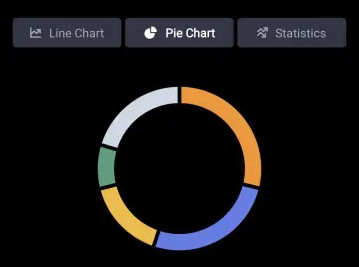
This was the main disappointment. The mobile portfolio shows best and worst performers, but no individual profit-and-loss column per coin. The desktop version has that. On mobile, if you hold more than five assets, everything past five gets dumped into an "other" slice on the chart. Desktop gives each coin its own sector. If you depend on per-asset P&L or detailed allocation views, you'll need the desktop version - or a better portfolio app for crypto that keeps that detail on mobile.
What to Look for When Picking Altcoins
Altcoins are everything besides Bitcoin - Ethereum, Ripple, Litecoin, and thousands of smaller tokens. They can offer faster transactions, different use cases, and higher potential returns. They also come with higher volatility and risk. Here's what the research checklist looks like:
Altcoin research factors
- Market cap - helps separate established projects from high-risk ones, but don't use it alone
- Technology and development - strong team, active commits, clear roadmap, viable tech
- Adoption and use case - real purpose, actual users, growing traction
- Trading volume and liquidity - can you enter and exit without moving the market?
- Reputable sources - forums, news, dev updates, on-chain data like Glassnode
- Diversification - mix established names with smaller positions, set realistic expectations
Market Cap as One Filter Among Many
Market cap helps you size up a project, but it's one filter. A large cap crypto might be stable but slow-growing. A small cap might 10x or go to zero. You need the tech story, the adoption evidence, the liquidity picture, and the narrative context all together. That's why you check crypto currency lists alongside dev forums and on-chain metrics - they measure different things.
Meme Coins Show How Fast Attention Shifts
CoinMarketCap's weekly notes by Alex O'Donnell capture this well. In one snapshot, total meme market cap fell 3.5% week over week while Solana dropped 8.5%. But daily launchpad volume on Solana still ran near $100 million - down from a $182 million peak, but well above December lows. New tokens averaged 30,000 launches per day. The sector was cooling, but the factory kept running.

When Most Visited Doesn't Match Top Market Cap
The top five by market cap: Dogecoin, Shiba Inu, Memecore, Pepe, Official Trump. But the most-visited list? Pippin, Dogecoin, Shiba Inu, Pepe, Official Trump. Pippin wasn't in the top five by cap, but it was the most visited. Attention and market value are different things. A coin can trend hard without cracking the cap rankings.
Thinking about an altseason right about now? Neither is anyone else. Historically, however, moments like these when social volume toward altcoin interest is at extreme lows are around the time that rallies begin.
Headline-Driven Spikes and What They Mean
Some tokens move on pure narrative. WAR jumped from under $7 million to $30 million in a few days. OLIO went from $2 million to $5 million. Older tokens like MAXXING, PIGEON, and LIZARD spiked above $1 million again. The driver: geopolitical headlines. These moves reflect short-term attention, not changes in revenue, users, or development. If you're searching crypto what to buy now based on spikes like these, you're trading attention, not fundamentals.
Pump.fun Expanding Beyond Just Meme Launches
Pump.fun acquired Vyper and Padre (now TradingTerminal), then started a $3 million hackathon judged by Tim Draper. They also added trading for tokens from other launchpads, plus WBTC, PUMP, USDC, and more. The playbook: combine launches, discovery, trading, and analytics in one on-chain interface. It's a trading platform cryptocurrency play now, not just a launchpad. Base App sunset its creator rewards to prioritize trading too - Jesse Pollak said the app needs one primary focus.
Stablecoin Research Goes Way Beyond Market Cap
Arthur Hayes's deep dive on Ethena and Tether shows why stablecoin analysis needs more than a market-cap number. Tether (USDT) is the largest by circulation, backed by dollars in bank accounts. But those banks - Britannia, Cantor Fitzgerald, Capital Union, Ansbacher, Deltec - mostly lack Fed master accounts. They rely on correspondent banking. If a correspondent cuts ties, dollar movement gets hard. That's a structural fragility a market-cap ranking won't show.
Physically Backed vs Synthetic Stablecoins
Physically backed means fiat in a bank (Tether, Circle, First Digital). Synthetic means crypto collateral plus a short derivative hedge (Ethena). The risks are different. Physical depends on banking relationships, custody, redemption ops. Synthetic adds derivatives exchange exposure, funding rates, smart contract risk, and the crypto-dollar basis. Neither is risk-free.
Why Tether's Banking Relationships Create Fragility
Tether needs banks for three things: creating USDT, custodying dollars, redeeming USDT. But non-U.S. banks need U.S. correspondent banks to clear dollars. Smaller banks shy away from crypto clients due to compliance risk. If a correspondent relationship ends, the bank loses international dollar access. Tether's named partners are mostly non-U.S., and only Cantor Fitzgerald is U.S.-domiciled - but it's a primary dealer, not a traditional bank. The whole chain depends on counterparties that can change their risk appetite overnight.
Tether's named banking partners
- Britannia Bank & Trust
- Cantor Fitzgerald
- Capital Union
- Ansbacher
- Deltec Bank and Trust
Ethena's Yield Model and Its Own Risks
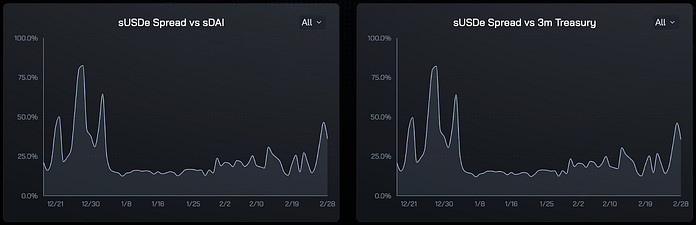
Ethena's USDe combines staked ETH yield with short ETH/USD perpetual funding. At one point sUSDe yielded over 50% APY; later around 30%. The yield comes from two sources: ETH staking rewards and positive funding rates (longs pay shorts). Hayes argues ETH stays scarce/deflationary while dollars expand, keeping perpetuals at a premium to spot. But if funding turns negative long enough, the hedge loses money and USDe can depeg.
Ethena is For Us, By Us, aka FUBU. Tether is For Us, By Them, aka FUBAR.
What a Market Cap App Can't Tell You About Stablecoins
A token's market cap or dollar peg won't reveal: circulating supply dynamics, collateral composition, exchange counterparty exposure, redemption terms, staking mechanics, funding rate history, insurance fund size, or smart contract audit status. Ethena's insurance fund started at $16 million - USDT, USDC, stETH, and LP positions. Its governance token valuation model depends on protocol revenue, staking ratios, and whatever multiple the market assigns. None of that shows up in a list crypto coin ranking.
Putting Research Together Before You Trade
The pattern across all this: a market-cap app is a dashboard, not a research department. It organizes prices, caps, volumes, and rankings. It doesn't replace reading dev updates, checking on-chain data, understanding tokenomics, or assessing counterparty risk. Use it to spot candidates, compare size, set alerts, and track portfolio snapshots. Then go deeper. Check forums. Read the news. Look at trading data. Verify the team is shipping. If you're evaluating ai crypto trading bot signals or bots crypto strategies, the same rule applies - the app gives you the what, you still need the why. And hey, if you're on Gemini, those gemini codes for fee discounts are worth grabbing, but they don't replace due diligence either.




Comments on “What to Check Before Choosing a Coin Market Cap App for Crypto Research”
No comments yet. Be the first to share your thoughts.