
How Pooling Works in Crypto Mining and What to Check Before Joining
If you have looked into how to mine crypto , you have probably seen two main choices. You can mine alone, or you can join a mining pool. In pooling mining, several miners combine their computing power and split the work and rewards. For a small miner, this usually means more regular payments, but it also means trusting a pool operator with your balance and mining work.
Pooling generally gives miners more frequent and predictable payouts, but it also introduces fees, operator dependence, pool-management risks, and concerns about hashrate centralization.
What Pooling Mining Means
In proof-of-work mining, miners compete to solve a math problem. The first miner to find a valid answer gets the right to add the next block. A block can hold thousands of Bitcoin transactions. The winner receives a block subsidy and, in most cases, the transaction fees paid by the people whose transactions were included.
What happens during pooled mining
- A miner connects mining software to a pool and sends computing power to it.
- The pool gives each miner work based on a shared block template.
- Mining software tries many possible values called nonces.
- Results that meet the pool's easier target are sent back as shares.
- When one device finds a full block, the pool sends that block to the Bitcoin network.
- The pool divides the block subsidy and transaction fees under its payout rules.
An accepted share is proof that a miner did work for the pool, but it is not a full block. A share must meet an easier target than the Bitcoin block target. This lets the pool pay for ordinary work instead of waiting for a rare block discovery. The block still may not arrive when expected, so pool luck affects short-term earnings.
Why Solo Mining Has High Variance
Bitcoin is designed to produce a block about once every ten minutes on average. That does not mean every block arrives on schedule. A solo miner can spend hours or days on electricity, cooling, internet service, and hardware costs without finding a block. Variance is just a fancy way of saying that the results swing between big wins and long dry spells.
A historical example from June 19, 2014 shows the size of that risk. At that time, the network had about 100 PH/s of hashrate. A 1 TH/s ASIC would have been one-thousandth of the network, with about a one-in-100,000 chance of finding each block. Under the network growth assumptions in that example, the device had a 15.9% chance of earning a reward during its assumed life and an 84.1% chance of earning nothing. Those figures belong to 2014 network and subsidy conditions, but the basic problem still holds.
The underlying reason for pooling remains: a solo miner’s payment depends on an infrequent, high-variance event, while a pool can pay for ordinary shares as they are submitted.
What a Mining Pool Does
A mining pool is usually run by one organization. It connects member devices, hands out work, collects results, and sends any valid block to the network. It also keeps track of balances and pays miners. Most public pools are centralized services, even though the Bitcoin network itself is designed to work across many independent participants.
Pool operator duties
- Choose or build a block template.
- Send mining jobs to member devices.
- Receive and check mining shares.
- Broadcast valid blocks found by members.
- Track each miner's accepted work.
- Deduct fees and calculate payouts.
- Hold balances until the minimum payout is met.
- Send Bitcoin through a wallet or another supported payment method.
The pool has control that a solo miner does not. It holds unpaid rewards, decides which transactions enter its templates, and can change fees or payout terms under its service rules. That does not mean every operator is dishonest. It does mean payout history, security, and clear fee terms matter a lot.
How Hashrate and Shares Are Split
Hashrate is a measure of mining computing power. More hashrate gives a miner or pool a better chance of finding a block over time. It does not guarantee a block at any set time. In a common pool design, the operator gives each device a set of nonces to try. Each nonce is another guess at the mining answer, and each guess uses power and time.
Terms you will see in pool software
- Hashrate: The total computing power applied to mining.
- Share: A result that meets the pool's easier share target.
- Accepted share: A share that the pool accepts and credits.
- Rejected work: A result the pool does not accept for payment.
- Block target: The harder result needed to add a full block.
- Pool luck: How close the pool's recent block results are to what its hashrate would suggest.
The pool also builds or selects the block template. That template holds the transactions, coinbase data, and header fields used for mining. Some pools let miners request a policy, such as a template that avoids ordinals or seeks the highest payout after fees. Other pools use one standard template. The people who build templates have power over which transactions can enter a block.
Solo Mining vs. Pool Mining
Solo mining gives you direct control over a block reward when you find one. You also choose your own template and do not pay a pool fee. The catch is big. Your payment depends on one device or site winning a network contest, and the required hardware and power setup can be costly. Pool mining lowers that block-finding risk but adds fees and dependence on the operator.
Solo mining
- You control the block template and broadcast process.
- You keep the full block subsidy and transaction fees when you find a block.
- You face much larger swings between rewards.
- You need enough scale to have a reasonable chance of finding blocks.
Pool mining
- Your accepted shares build a claim on pool rewards.
- Payouts are usually smaller and arrive more often.
- The pool takes a fee and may hold funds until a payout threshold.
- You give up some control over transaction selection and infrastructure.
A smaller payout arriving more often does not mean the reward is economically larger. The expected value still depends on the total work performed, pool efficiency, fees, and cryptocurrency prices.
A large mining site with strong hardware may still choose solo mining. A small home miner usually gets more value from the drop in reward swings. The right choice depends on your hardware scale, power cost, risk tolerance, and need for regular cash flow.
Common Pool Payout Methods
A Bitcoin block's gross reward is the block subsidy plus its transaction fees. Scheduled halvings reduce the subsidy, while transaction-fee revenue changes with network activity. A pool can divide that reward in several ways. The method matters because it decides who carries the risk and when a miner gets paid.
Payout methods you may see
- PPS: Pay Per Share pays for each accepted share. The pool carries the risk that it will not find enough blocks to cover those payments.
- FPPS or PPS+: These methods account for expected block and transaction-fee rewards, with the exact formula set by the pool.
- PPLNS: Pay Per Last N Shares looks at recent shares between blocks. A miner may receive nothing during an interval with no pool block.
- Score-based methods: These give recent accepted work more weight and are often used to reduce simple pool hopping.
PPS can make payment timing easier to predict because the pool pays for shares even when it does not find a block. PPLNS can leave more short-term variance because a miner needs recent shares and the pool must find a block. No method is free. Compare the fee, transaction-fee treatment, minimum payout, and payment delay instead of looking at the label alone.
What Affects Pool Mining Profitability
Joining a pool can be useful, but it does not guarantee profit. Pooling mining changes how rewards are divided. It does not remove electricity costs, hardware wear, market swings, or network difficulty. A simple profit check starts with expected rewards and then subtracts every cost needed to keep the rig running.
Profit factors to record
- The market price and price swings of the mined coin.
- Your accepted hashrate and rejected work.
- Total network hashrate and mining difficulty.
- Hardware purchase cost and expected useful life.
- Electricity price and power draw.
- Cooling, space, internet, and maintenance costs.
- The pool fee and any extra deductions.
- The pool's recent block-finding record.
- The payout method and minimum payment.
- Transaction-fee revenue and how the pool divides it.
You can work through the math in plain steps. Start with the reward your accepted shares should earn. Subtract the pool fee, power bill, hardware replacement money, internet, cooling, and maintenance. Then compare what remains with the value of the mined coin. A calculator such as WhatToMine can help test power limits, but its answer is only an estimate because network difficulty and coin prices move.
Pool Fees and Hidden Deductions
A pool fee is a cut of the miner's reward or reward stream. A 1% to 2% fee is common enough to use as a rough comparison, but the pool's stated terms are what count. A fee that looks small can matter when the coin price is low or power costs are high. The fee also becomes more important when a home miner's margin is already thin.
Deductions and payment conditions to check
- The main pool fee and when it is deducted.
- Withdrawal or Lightning routing charges.
- The minimum payout amount.
- Payment delays for security or account checks.
- Coinbase transaction costs taken by the pool.
- Account fees, if the pool charges any.
- Rules for balances that do not reach the payout threshold.
Ask whether the fee comes before or after transaction-fee revenue is divided. Ask what happens to unpaid balances if you stop mining or close the account. A clear pool should answer these points without forcing you to dig through support tickets. Hidden charges and vague math are good reasons to look elsewhere.
Hardware, Power, and Cooling Costs
Bitcoin mining changed when purpose-built ASIC chips arrived in 2013. An ASIC does one narrow job and usually gives more Bitcoin hashing power than a general-purpose GPU, but it cannot handle other computing tasks. GPUs can make more sense for some other cryptocurrencies because they can use broader software. Check the coin, algorithm, device, and pool before buying or connecting anything.

Costs beyond the mining reward
- ASIC or GPU purchase cost.
- Electricity used by the mining devices.
- Power used by fans, pumps, and cooling.
- Air conditioning or other cooling costs.
- Space and electrical capacity.
- High-speed internet service.
- Mining software and pool account costs.
- Replacement parts and worn-out hardware.
Wrong software settings can cut hashrate, and some incompatible settings can damage equipment. A home miner may use some waste heat for space heating, but that does not erase the mining power cost. A large facility gains room for scale and shared cooling, yet it also needs stronger infrastructure. Check that your hardware and software are supported before you judge the pool.
Pool Hopping and Short-Term Choices
Pool hopping means moving hashrate based on recent blocks, estimated yield, or another pool's payout record. It can raise short-term income when one pool happens to be having better luck. It can also make your own reward history harder to read because every new pool starts with a different block and payout pattern.
Details miners compare when choosing a pool
- Estimated reward after pool fees.
- Recent block discoveries.
- Payout method and minimum amount.
- Payment speed and payout history.
- Network distance and mining latency.
- Transaction-selection rules.
- Lightning support.
- Downtime and support response times.
PPLNS and score-based payouts make it harder to join after a block, collect one short payment, and leave before the next block. They can also make you wait until you build enough recent shares. Frequent switching interrupts accepted work and leaves balances tied up during settlement. A pool choice should include payout trust and fit, not just the luckiest number on a stats page.
Block Templates and Transaction Choice
The pool operator does more than split coins. It also decides which transactions go into the block template. Miners supply proof-of-work computing power, but the party that builds the template has strong say over what the block includes. That makes template rules part of the pool's service, not just a technical footnote.
StratumV2 transaction-selection modes
- Disabled: The pool does not accept client-selected work and uses its own template setup.
- Client-push: Clients build and send their own templates to the pool.
- Client-negotiated: The pool offers templates, records them, and validates work against the offered choice.
Client control can reduce the pool's control over transaction selection, but it creates a new trust problem. A client could send shares based on an invalid template, collect share payments, and hide a valid block. Full checking costs computing power and may fail when many clients send conflicting transaction sets. A client-negotiated design offers choices, but the pool still needs records, validation rules, and a way to publish a valid block.
Specialist template builders, outside fee payments, and transaction-accelerator services have also been discussed. These ideas may give miners more ways to earn fees, but they do not by themselves settle the risk of one party controlling templates. Ask what a pool permits, what it logs, and what happens if a client sends work that fails validation.
Pool Centralization and Censorship Risk
A larger pool finds blocks more often and can give members steadier payments. That same size can raise network-level concerns if one operator or linked group controls too much hashrate. Concentration does not mean censorship is happening at once. Separate pools can still offer competing templates. The risk grows if large pools agree, hide common control, or block miners from using other templates.
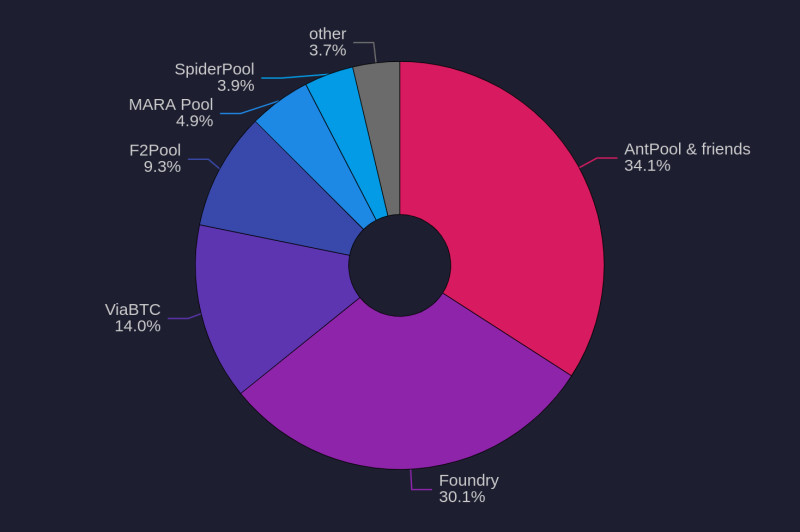
What pool concentration can affect
- Which transactions enter block templates.
- How transaction-fee revenue is handled.
- Whether network outages or attacks spread across many miners.
- Whether several pool names are controlled by one owner.
- How much power one group has over competing templates.
- How easily members can move away from the pool.
A 51% attack does not automatically allow an attacker to create arbitrary new Bitcoin or directly take coins from every wallet. The principal danger is reversal or exclusion of transactions.
A group with more than half the network's computing power could try to exclude transactions or reverse recent blocks. Miners may refuse to join such an attack because they would risk their own earnings and the network's trust. In June 2014, GHash.io reportedly passed 45% of Bitcoin network hashrate and reached 51% at one point. Miners quickly moved away, which showed both the power of concentrated pools and the value of being able to leave.
Block Withholding and Trust Problems
Block withholding happens when a miner submits normal-looking shares but keeps a valid block instead of sending it to the pool. A simple two-pool model from 2015 showed how this could increase an attacker's total reward, even though some of its own power was wasted. The model was simplified, but it exposed a real trust problem between a pool and its members.
Why detection gets hard
- A small miner may not be expected to find a block for months or years.
- An attacker can split power across many accounts.
- Many honest miners can look unlucky when grouped together.
- Different miners may work on different transaction templates.
- A valid block for one template may not fit another template.
- A pool may see accepted shares but have little proof of withheld blocks.
Possible defenses include identity checks, minimum hashrate rules, statistical monitoring, full template checks, larger block-finding bonuses, account bans, rate limits, and published templates. Each choice costs something. Strong identity rules can push small pools toward KYC and fewer members. A block bonus can add payout swings. Full template checks can burden the pool's servers. Proposals for shares that hide whether work is also a block could require protocol changes, node upgrades, and miner software tests.
What to Check Before Joining a Pool
Hey, don't skip this part. The pool can look simple from the outside, but your balance and work pass through its systems. A long operating history does not promise future service, but a lack of history leaves you with little proof to judge. Payout records and clear fee terms are more useful than a splashy reward estimate.
Pool questions I would answer first
- Reputation: Is there a visible operating history with real payout records?
- Pool fee: What percentage is taken, and are there other charges?
- Payout method: Does the pool use PPS, FPPS, PPS+, PPLNS, score-based pay, or another rule?
- Block risk: Who carries the risk when the pool fails to find a block?
- Transaction fees: Are fees shared, deducted, or kept by the operator?
- Minimum payout: How much must build up before a payment can be sent?
- Payment timing: How long do balances settle, and can that time change?
- Pool size: How much hashrate and block history does the pool show?
- Security: Does the operator update software, monitor systems, and test its infrastructure?
- Support: Will the operator answer questions about rejected shares and missing balances?
- Compatibility: Does the pool support your device, coin, algorithm, operating system, and mining software?
- Wallet rules: Does it pay to a normal wallet, Lightning, a pool account, or only an exchange address?
- Identity checks: Is KYC required, and what information is kept?
- Transaction policy: Who builds templates, and can clients request a policy?
- Leaving: Must your balance clear before you can move to another pool?
A new or little-known pool that holds payments for more than one or two days deserves a hard look. So do unexplained balance changes, unclear fee deductions, repeated support failures, or a stats page that never changes. Test with a small balance and watch the first payout before treating the pool as a long-term home for your hashrate.
Payout reliability is the most direct test of whether the operator is honoring the agreement.
Wallets, Lightning, and Leaving a Pool
Pool payouts can go to a normal Bitcoin wallet, a Lightning wallet, a pool account, or another method the operator supports. A self-custodial wallet means you hold the keys and do not need to leave funds on a centralized exchange. Some pools support small Lightning payments, while others use a minimum amount that must build for a while. Lightning support is pool-specific, so check it before choosing a rig setup.
Payout setup details
- Supported wallet and payment method.
- Minimum on-chain payout.
- Minimum Lightning payout.
- Network or routing fees.
- Identity-check rules.
- Whether the pool can hold funds for an account.
- How unpaid balances behave when mining stops.
- How to export or withdraw the full balance.
Before adding power, learn how to leave. A balance may need to clear, and a payout already in progress may not move to the next pool. Make sure the next pool accepts your hardware and wallet. Keeping your own wallet, account details, and payout records in order gives you more control if the service fails or you decide to move.
Pool Mining and Coin Buying Are Different
People often mix two questions. What crypto to buy asks where to place money. How to mine crypto asks how to spend power and hardware to earn rewards. Pooling mining answers only part of the second question. It can change payment timing, but it cannot set the coin's price or make an unprofitable rig profitable.
Advice about how to invest in crypto or crypto coin investments may be affected by the same price swings, but it will not tell you whether your pool fee leaves money after power and cooling. Searches for what to buy in cryptocurrency , crypto currency lists , or the best cryptocurrency to buy can help sort assets. They do not measure your rig.
Questions about coin market cap or large cap crypto also belong to the asset side of the decision. A pool cannot prove that a coin is a sound choice. It can only show how work, fees, and payouts are handled. Keep the mining records separate from the coin-buying decision.
What I would record before joining a pool
- The coin and algorithm supported by my hardware.
- My power price and measured electricity use.
- Cooling, space, internet, and maintenance costs.
- The pool fee and every possible deduction.
- The payout method, minimum payout, and payment delay.
- The pool's recent block record and payout history.
- Its security, support, identity, and template rules.
- My wallet type and exit steps.
- The coin price I need to cover costs without relying on one lucky block.


Comments on “How Pooling Works in Crypto Mining and What to Check Before Joining”
No comments yet. Be the first to share your thoughts.