

Crypto on Casper: How the Network, Wallets, and Uses Fit Together
If you are searching for casper crypto , I would start with four parts: the network, the CSPR token, smart contracts, and wallets. Casper Network is a layer-1 blockchain, which means it is a base network that other apps can use. If you have ever asked what blockchain technology is , think of a blockchain as a shared record kept by many computers. People check the same chain of blocks, while network rules decide who can add data or confirm changes.
The four parts do different jobs. The network runs the rules and reaches shared decisions. CSPR pays for network activity and helps secure the chain through staking. Smart contracts are programs that run on the chain, and wallets hold keys and sign actions. A token can exist without every planned app being ready, so keep those layers apart when reading claims about casper crypto.
The casper crypto map
- Casper Network: the layer-1 blockchain and its consensus rules.
- CSPR: the native token used for fees, staking, and some app activity.
- Smart contracts: code that holds rules, moves assets, or records data.
- Wallets: tools that manage accounts, keys, CSPR, tokens, and NFTs.
- Applications: NFT markets, finance tools, bridges, and business record systems built on the network.
The hard part is not learning a pile of crypto words. It is seeing which claims belong to the network, which belong to CSPR, and which describe a project, pilot, or plan. That distinction matters because Casper crypto includes both working pieces and ideas that were still being built.
What Casper Network Is Built For
Casper is described as a permissionless, decentralized public network. Permissionless means people can build on or use it under its rules, while validators take part through proof-of-stake work. Its contracts use WebAssembly, or WASM, which gives them a common way to run. “Turing-complete” means the contract setting can carry out broad computing tasks, not just one hard-coded action. Casper materials also point to predictable fees, contract and network upgrades, on-chain governance, privacy options, and weighted account keys.
Main parts of the network design
- A public layer-1 chain with validators and a native token.
- Proof-of-stake consensus instead of proof-of-work mining.
- WASM-based smart contracts with broad computing rules.
- Contract-level upgrades and network-wide upgrade paths.
- Weighted keys, delegation, account permissions, and privacy choices.
- Public, private, and mixed deployment options.
These are design goals and stated features, not a promise that every app will have the same cost or setup. The network wants common blockchain rules while giving builders choices about access and control. That mix sits beneath much of the Casper crypto story.
Why Casper Uses Proof of Stake
Most source documents call Casper a proof-of-stake network that uses CBC Casper consensus. One wallet article described CBC Casper as a mix of proof of stake and proof of work, while network reviews, the Casper AMA, and other project materials place it in the proof-of-stake camp. To explain crypto mining in plain words, mining is a way to spend computing work to compete for the right to record blocks. Proof-of-stake systems use staked coins and validator roles instead of that mining race. A search for how to mine cryptocurrency on Casper leads to a dead end, and any page promising to mine crypto for free there should make you ask hard questions.
Key points in Casper's research history
- Zamfir's early proof-of-stake work grew from Bitcoin and altcoin research around 2013.
- In 2014, he studied Ethereum, peer review, Slasher, and security deposits.
- A long discussion after an Ethereum meetup convinced him that proof of stake could work.
- Pink Penguin began sponsoring the proof-of-stake research in 2014.
- CasperLabs began work on the Casper codebase in October 2018.
“Nothing at stake” was the weak point that early Casper security research tried to close.

Vitalik Buterin described Slasher, which could remove a validator's block reward for signing conflicting blocks. Zamfir tied that idea to security deposits, so a validator could lose more when it broke the rules. The basic idea was economic loss: honest validators can keep earning, while faulty behavior can cost them rewards or stake.
CasperLabs and the Casper Association
Two Swiss-based groups have different roles. CasperLabs is a software and services company that contributes code and builds Casper projects with customers. The Casper Association is a not-for-profit that stewards the open protocol, supports network growth and decentralization, and works with validators and other contributors. In short, CasperLabs builds and serves, while the Association focuses on the protocol and its wider node base.
How the main groups fit around Casper
- CasperLabs contributes software features and developer tools.
- CasperLabs also offers consulting and project services.
- The Casper Association oversees and stewards the open protocol.
- Association members include independent validators that run Casper nodes.
- Both groups work with developers, validators, and other contributors.
Casper can also be deployed in more than one way. A builder can use the public network, run a private setup, or connect a private system to the public chain. The Casper AMA once called a fully public option a “fully pirate deployment.” That odd phrase meant no permissioned gatekeepers, not a change to the protocol rules. Private and mixed setups can add access rules while still needing to follow applicable law.
How Casper Smart Contracts Work
Casper runs smart contracts through WASM in a Turing-complete setting. In practical terms, a contract can encode a rule and act on it without a person handling each step. Casper materials name Rust and AssemblyScript for contract work, while other descriptions also mention TypeScript, C++, and JavaScript. The aim is to make the network less alien to developers who already use common tools. A contract can live at an immutable address or a permissioned reference, decide which contracts may call it, and change after launch.
Developer and contract features in the source material
- Rust and AssemblyScript support, with other web and systems languages mentioned.
- A contracts SDK, runtime, test harness, and command-line chain queries.
- Turing-complete payment code that can run in one transaction.
- Immutable or permissioned contract references.
- Rules for which contracts may call another contract.
- Contract upgrades and network-wide upgrade paths.
- Weighted keys, delegation, key management, and flexible account control.
- A review that described consensus as needing at least two-thirds of validators.
“Provably live and provably safe” was Mrinal Manohar’s claimed description of CBC Casper.
That quote is a project leader's claim, not an independent test result. The same AMA compared Casper with Ethereum, Solana, Polygon, EOS, Stellar, Algorand, and other networks. Those comparisons show Casper's pitch, but they should not settle a head-to-head technical debate.
What CSPR Does on Casper
CSPR is Casper's native layer-1 token. Its main jobs are paying for transactions that use network resources and supporting consensus through staking. Fees give value to validators and help limit spam. CSPR can also pay for NFT actions, token moves, bridge use, and decentralized finance tools. If you have heard what staking in crypto means , the short version is that participants commit coins to help secure a proof-of-stake network. On Casper, validators can take part in consensus, and delegators can delegate stake to a validator. Weighted keys can carry authority for accounts and deployments. Delegation does not make CSPR risk-free, since the token can still lose value.
The main roles of CSPR
- Pay transaction fees that consume network resources.
- Support consensus through validator and delegated stake.
- Pay for many NFT, bridge, token, and finance actions.
- Give weighted keys authority over accounts or deployments.
- Act as the economic asset in Casper-based apps.
One dated network review put the average Casper transaction at about one cent in CSPR. That was a historical snapshot, not a promise for every transaction. Fees can change with the work a contract does, network demand, or protocol rules. This is the part many people mean when they search for casper crypto, but it is only one part of the network.
Casper's Mainnet Launch and Early Network Snapshots
Casper mainnet launched on March 31, 2021. It followed a CoinList token sale that reported more than 270,000 participants and $33.5 million in token sales. A first-anniversary review counted more than 16,000 delegators, more than 70,000 accounts, more than 480,000 contract deployments, and more than 385,000 native CSPR transfers. These are dated facts and snapshots, not measures of the network as it stands now.
A separate 2022 network snapshot
- 76,070 wallets and accounts.
- 17,070 delegators.
- 239 connected nodes and 100 validators.
- 197 bids to join consensus.
- 471,854 total token transfers.
- 5.14 billion CSPR in circulation and 10.93 billion in total supply.
- 8.26 billion CSPR staked, reported as 75.52% of total supply.

The figures were not all measured the same way. The first-anniversary review counted more than 16,000 delegators, while the separate 2022 snapshot listed 17,070. I would use these numbers as historical markers for early growth, not as a live dashboard or price signal. A dated wallet or exchange listing also does not prove that the service remains available.
CSPR Wallet Choices
The source set names an official Casper wallet, Torus Wallet, CoinRabbit Wallet and Exchange, and hardware wallets such as Ledger and Trezor. The official wallet was described as a place to store and manage CSPR, with encryption, backup choices, and multi-factor authentication. Torus was described as supporting Casper accounts, NFTs, and token-like assets. CoinRabbit was presented as a service that combines storage, exchange, and borrowing features.
Wallet types named in the source material
- An official Casper software wallet for storing and managing CSPR.
- Torus Wallet for Casper accounts, NFTs, and token-like assets.
- CoinRabbit Wallet and Exchange as a combined service.
- Ledger models listed as having native CSPR support in an early review.
- Trezor or Ledger models only when the exact product supports Casper.
Hardware storage is often presented as the safer home for a large long-term holding because the keys stay on the device. That does not remove every risk. A weak setup, fake support page, lost device, or bad seed backup can still cause loss. I would check the maker's live support list before sending a large amount of casper crypto.
Buying and Storing CSPR
If your question is what to buy in crypto , CSPR should be one choice among many, not the answer by default. Buy only when you understand why you want the token, how much you can lose, and which wallet and exchange rules apply. A wallet guide raised the possibility of CSPR reaching $100, but it gave no named analyst, model, target date, or chance of success. I would treat that number as a story, not a forecast. The guide named Binance, KuCoin, and Gate.io as places where CSPR had been available, while also saying buyers should compare fees, trading pairs, security controls, ease of use, support, and user reviews.
A safe CSPR transfer and storage check
- Download wallet software only from an official site or trusted app store.
- Use a strong password that does not include easy-to-guess personal details.
- Turn on two-factor login when the service offers it.
- Check the crypto address against the sender's source for every transfer.
- Send a small test amount before moving a larger balance.
- Keep wallet software updated for bug and security fixes.
- Keep private keys and recovery phrases offline and away from online storage.
- Store more than one secure offline backup in separate safe places.
- Never give a private key or recovery phrase to another person.
Disclosure of a private key or recovery phrase grants access to the funds.
Hey, this last part matters most. Crypto transfers cannot be reversed like a bank payment. Once a key or recovery phrase leaks, the money may be gone, and no support desk can undo it.
NFTs on Casper
Casper's NFT support is meant to go beyond digital pictures. Project materials listed tickets, coupons, identity records, patents, land rights, product certificates, supply-chain records, music, and files. The idea is to put a unique token on-chain while other data or rules describe what it represents. Casper's CEP-78 contract uses a factory pattern, so builders can install different NFT contract types. Its metadata can also change to reflect a new state, such as a ticket moving from valid to used. The contract author decides how upgrades work.
NFT and record uses described by Casper
- Tickets and coupons that can change state.
- KYC or identity records under an organization's rules.
- Patents and proof of ownership.
- Land rights and product certificates.
- Supply-chain records tied to physical goods.
- Music and limited-edition fan assets.
- Files or data tied to connected devices.
- Marketplace items made through Casper tools.
WiseArt, MAKE, and Brooke Shields were said to have made the first NFT minted in outer space.
That outer-space claim came from CoinList and was tied to a linked-device story. Other named projects included Metacask.io, DMusic, DGallery, Wise.Art, Friendy.Market, and CasperNFT.market. A named project does not prove that its marketplace or contract is operating, so check the chain records, contract, and project site before buying.
Enterprise and Real-World Uses
CasperLabs uses the term “enterprise-grade” to mean familiar tools, support, predictable costs, maintainable code, and a network that can fit organizations of different sizes. It does not mean Casper is only for giant companies. The same source points to public, private, and mixed deployments, privacy choices, business key management, upgrade paths, and professional teams that build with customers. Casper's pitch is often about fitting blockchain work into systems that already have rules, budgets, and people responsible for them.
Named Casper use cases
- IPwe used Casper NFTs for public patent records, ownership, status, and transfers.
- Metacask used NFTs for whisky casks tied to registration, verification, and ownership.
- WISeSat was linked to devices that could record a product's location and condition.
- DMusic planned music NFTs and ways for artists to share income with fans.
- CasperLabs and IBM built an atomic token swap between Casper and Hyperledger Fabric.
- Casper and Stobox planned token models for parking properties and revenue shares.
“Tokenization of parking assets... is the next logical step in bringing the parking industry on-chain.” - Michael Steuer
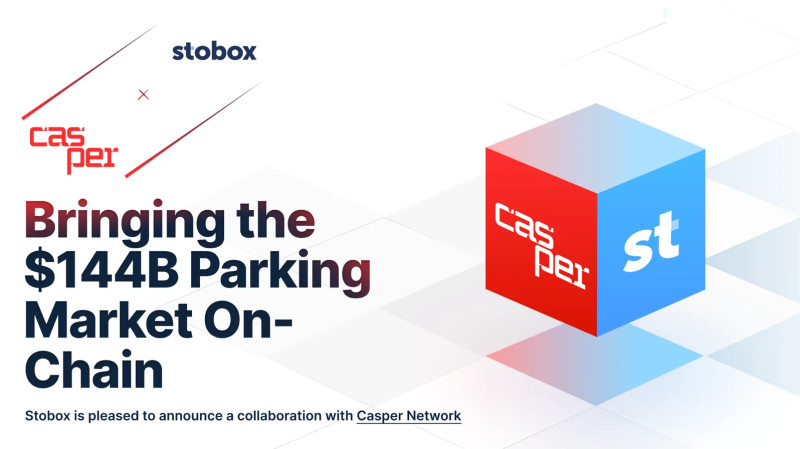
The parking partnership announcement put the U.S. parking market at an estimated $144 billion. Its model was to split property ownership into smaller tokenized pieces and direct revenue toward token holders. That is a plan, not proof that every parking property has moved on-chain. The source also named a Government of Dubai blockchain initiative but gave little detail. IBM's example had more detail, using hash time-locked contracts and the Weaver framework so both sides could complete or fail together. A built example and an operating service still need to be separated.
DeFi, Bridges, and Financial Contracts
One dated CoinList source said Casper did not have active decentralized-finance markets before a planned protocol update. It expected bridges, NFT markets, decentralized exchanges, automated market makers, yield farming, and collateralized lending to follow. Those items were forward-looking, so the post shows planned work rather than proof that every product launched. Cross-chain work was a major part of that plan. The AMA described DotOracle as an AnySwap fork meant to connect Casper with BSC, Polygon, Ethereum, Avalanche, Fantom, and other EVM chains. Ferrum Network was also preparing bridges, while wrapped stablecoins and FRAX routes were discussed.
DeFi and bridge projects named in the sources
- DotOracle for links between Casper and other EVM-compatible chains.
- Ferrum Network bridges planned for BSC, Ethereum, and Polygon.
- Friendly.Market, CasperSwap, WiseSwap, and Swappery as market projects.
- Automated market maker, yield farming, and lending plans.
- Wrapped stablecoin routes through DotOracle and Change.Now.
- A native FRAX implementation described as under development in the AMA.
Casper also had plans for financial contracts outside consumer trading. CasperLabs and Ariadne formed Nucleus Finance to work on standard financial contracts, contract life cycles, and tokenization. Its aim was to make reconciliation and audit data easier to share, with some computation kept off-chain. The Casper Association also promoted ACTUS, an open standard for smart financial contracts. These ideas show a clear Casper crypto focus on money and records that traditional organizations already use.
Developer Tools, Grants, and Community Work
Casper opened a Developer Portal as a central home for docs, tutorials, and code samples. It was meant to help developers set up an app, join node work, or read the protocol without digging through scattered pages. A DevRewards program paid selected submissions in CSPR for work on NFTs, decentralized finance, SDKs, apps, and documentation. The stated rewards ranged from $100 to $1,000. The Casper Accelerate fund was described as $25 million for projects on Casper Public Mainnet, with work covering infrastructure, bridges, apps, games, NFTs, and research.
Programs described in the project material
- Developer Portal with docs, tutorials, and code samples.
- DevRewards for selected NFT, DeFi, SDK, app, and documentation work.
- A $25 million Casper Accelerate grant fund.
- Developer calls on Discord and broader community calls on X Spaces.
- Non-English Telegram and Discord groups.
- Hackathons and grants tied to apps, infrastructure, NFTs, and research.
“Maintain momentum through roadblocks, believe in your abilities, and keep studying.” - Medha Parlikar

The Accelerate program reported more than 600 applications and 45 rewarded grants in a 2023 reporting period. That is a historical count, not a promise about future funding. Medha Parlikar, identified as a CasperLabs co-founder and chief technology officer, also spoke about the lack of women in crypto. CasperLabs said it had paid for security audits and shared reports, including a Casper Highway audit by Trail of Bits. An audit can find code flaws, but its scope and fixes still need to be read.
Claims to Check Before You Act
The source material mixes technical descriptions, project posts, wallet articles, launch reviews, roadmaps, partnership news, and social media claims. That mix is useful for a big picture, but each kind has a different weight. A protocol document can explain a rule. A demo can show a build. A partnership announcement can state an intent. None of those alone proves adoption, profit, safety, or token value. Every casper crypto claim needs to be tied to the exact version, contract, or service involved.
Questions I would ask about a Casper claim
- Is the feature shipped in protocol code or only described in a roadmap?
- Is an app, bridge, wallet, or marketplace operating or only announced?
- Does a wallet model support Casper and the exact asset I want to hold?
- Is exchange access allowed where I live and allowed by the terms?
- Was a price target backed by a named model, analyst, date, and chance of success?
- Does an audit cover the exact contract or release I plan to use?
- Does a partnership name owners, users, data, fees, and rules?
- Are validator, governance, and network figures measured in the same way?
The AMA's claims that Casper was more decentralized, scalable, or safer than rival networks were the speaker's views, not side-by-side tests in the source. The source also included claims from an account called Casper CSPR News about leadership changes and token suppression. It included a post saying Casper Labs had become Prove AI and moved work to Hedera. Those posts offered opinions or announcements, but the supplied Casper material did not include proof of a governance transfer or the claimed shift. I would treat them as claims to verify, not settled facts.
A Plain CSPR Research Check
Before you buy, stake, delegate, bridge, or build on casper crypto, work through the sources in a fixed order. Start with the protocol docs and release notes, then check the official wallet or exchange page, then read the contract, audit, or partnership terms. Keep each claim tied to the exact network version or asset involved. A quick checklist cannot make a risky choice safe, but it can stop you from mixing up a plan with a working product.
My CSPR research checklist
- Read the protocol docs for fees, staking, delegation, account rules, and upgrades.
- Confirm that the wallet supports Casper and the exact token or NFT.
- Check exchange access, local rules, fees, pairs, and support before funding an account.
- Compare the address character by character and send a small test first.
- Keep private keys and recovery phrases offline and out of support chats.
- Read the full audit and check whether its fixes reached the release you use.
- Look for real users, contracts, activity, and uptime instead of announcement counts.
- Separate an operating product from a pilot, planned launch, or partnership idea.
- Treat price targets and social posts as claims, not forecasts or settled facts.
- Revisit the check when wallets, exchanges, protocols, or laws change.



Comments on “Crypto on Casper: How the Network, Wallets, and Uses Fit Together”
No comments yet. Be the first to share your thoughts.